There's probably a reason that I have never heard of tea-flavored yogurt, but I want to find out why for myself!
I definitely did not get any requests for this from my Review Board (roommates) but I have a LOT of tea, and a LOT of time (but not too much milk).
I realize that I always recommend searching online for info before starting a new experiment, but I am starting to lose trust in most blogs that mention ANY sort of microbiology. Not claiming that I know more than all of them, but many seem to recommend baseless actions...
Earl Grey Yogurt
Probably not the best choice to go along with yogurt since it already is a sort of bitter tea, but I have a large tin so that seems the best place to start. I drink Earl Grey regularly, but much prefer Victorian London Fog which is similar, but also has lavender.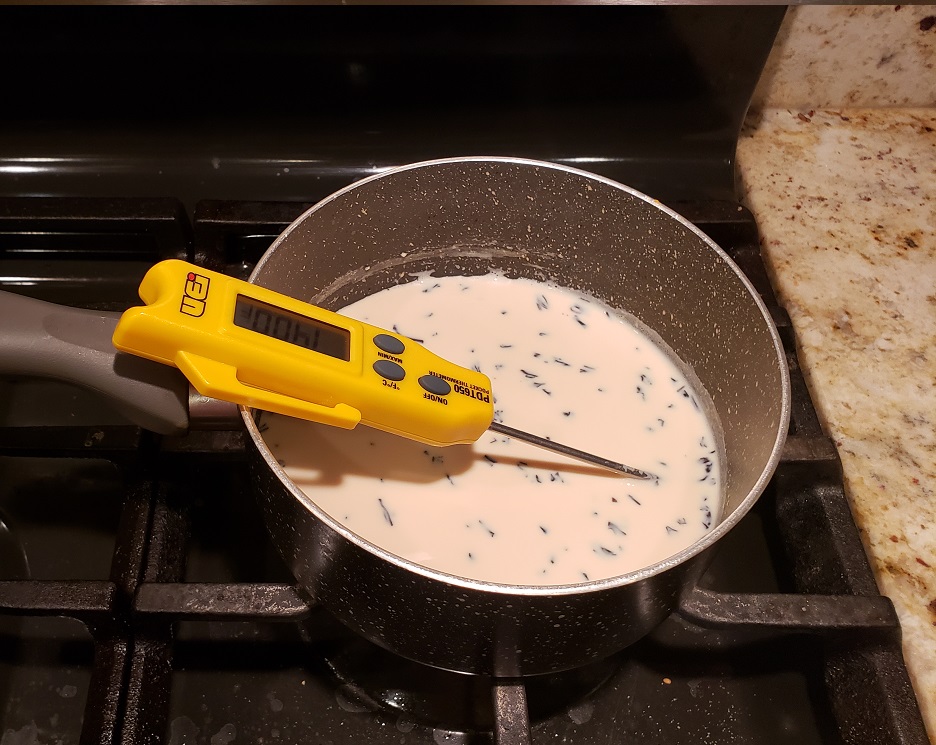
Follow very similar steps as when creating regular plain yogurt. The only difference is when prepping the milk before adding the culture. I used only 1 cup of milk (actually 215 g so probably less than a cup) to conserve my ingredients. Assuming the tea would not provide a strong flavor, I used just over what I would normally use for a cup of tea. I added 2 heaping teaspoons of Earl Grey loose leaf tea or 3 teaspoons of Victorian London Fog (two batches) to the milk just as it reached peak temperature (185°F). Earl Grey tea is on the bitter end of tea already, so I made sure to steep for only 3 minutes in the milk. The milk changed color immediately, but did not get very dark. I poured the milk through my tea strainer and returned it to the pot to cool.
I sometimes will use a water bath to cool the milk down, but find that I can clean the kitchen some while I wait, so maybe use this time to try to give yourself a few minutes to prep your starter and clean your work station.
After it cooled to 110°F, I added the culture just as normal. I used less than I normally would, hoping the batch might not be too strong.
Here is where I realized that I should not be starting this batch at 11 pm. If I truly wanted less sour yogurt, I would start in the morning and check it through the day to pull it when I like the flavor or consistency.
Anyways...I left the batch to go overnight as outlined in Getting Started with Yogurt. It turned out to be an ugly looking batch with a cratered top and watery texture.
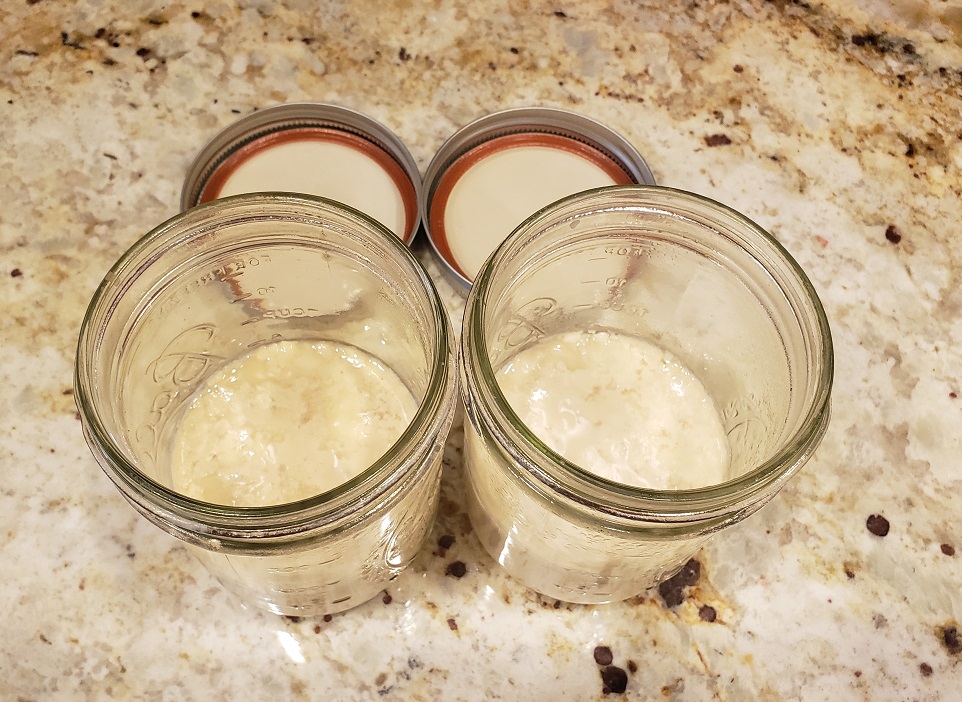
The smell seemed about right to me, but my Review Board did not agree. I set the yogurt in the fridge to see if it would set over the next few hours (remember to dig a small crater in the center to collect whey).
After checking 3 hours later, I did not find much whey separating even though it felt very thin. I laid the jar on its side in the fridge to try again.
A couple hours turned sideways separated a LOT of liquid that I poured off without saving.
Well did it taste okay?
No.
What was the problem?
I could definitely taste the tea flavor. I could also distinguish between the two kinds of Earl Grey that I used. The lavender came out clearly in the Victorian London Fog. The batch was just way too sour and bitter to be very enjoyable. I ate a bowl of the plain Earl Grey without pouring off any whey and it was really a battle from start to finish. The Victorian London Fog was much easier to eat since I had poured off so much sour whey. I think this flavoring would have gone better if I went for a much shorter fermentation and kept at a slightly lower temperature (maintaining a similar volume of starter).
An important note about milk: Milk will separate into curds and whey when it is too acidic (this is how you make ricotta, which I'll write about someday). The tea will definitely add a little bit of acid, but apparently not enough to separate while it is heating. I think it must be separating during culturing because of the acid, but I doubt any pH strips I could find will be sensitive enough to tell (also you can't very well use the strips on opaque solutions).
Moving forward
After making more plain yogurt I got sick of fiddling with the temperature every time so I did some tests with water instead of milk. I had been using plates to separate the ceramic dishes so the vapor would escape and heat up the mason jars more directly, but this backfires whenever I open up the cooler. Since condensation covers the entire inside of the cooler, opening the lid cools the jars and the styrofoam each time (remember that evaporation removes energy from wherever the liquid water came from). I started using the correct lids for the ceramic dishes and this helped keep the temperature more consistent: now the heat was transferred mostly by convection in the air with no change from condensation.
Batch 2
I took my notes from the previous attempt and tried to make it a bit less tart. I steeped the tea for a shorter amount of time when it was hot, choosing to use a bit more instead for stronger flavor.
Most of my batches of plain yogurt lately have been a little tart for others so I have made sure to practice toning it down a little bit. The timing for more agreeable yogurt is more difficult since I cannot leave it to culture overnight. 6-7 hours is just of time for it to mature before refrigeration. With my tests on water I found the right amount of boiling water that would bring the cooler to 124°F max in the air, but would bring the yogurt to no more than 114° or 116°. About 1.25 L of boiling water would take the yogurt from 105° (normal temperature after inoculating and mixing) to a safe maximum and let it cool down slowly.
This batch didn't look remarkable after culturing, no pitting in the surface this time, and not a whole lot of whey separation before refrigeration. After refrigation I decanted a small amount of whey and blended the yogurt. It was much more desirable this time and I had no trouble digging in.
I think that Earl Grey is NOT the right choice for a tea flavored yogurt. I will try chai next, possibly green tea or chamomile (whichever I have the most of).